Beyond the Bugibba Postcard

Grappa – A Unique Spirit in The World
July 26, 2026
Skills Pass & Pre-Departure: Raising Standards, Not Barriers
August 4, 2026
Most visitors to Malta are used to viewing Buġibba as
a holiday and party town, the seaside providing the
ultimate tourist backdrop.
Now, Żafżifa — a film written
and co-produced by Peter Sant, with Angelique Muller as
co-producer, offers a different perspective.
Buġibba is usually approached through
its most familiar images. Budget hotels,
bars, holiday apartments, the sea and
the churn of short-term visitors.
Żafżifa, the new Maltese film by writer, director and co-producer Peter Sant and producer Angelique Muller, introduces a new perspective as the town becomes a place under pressure, and a way of looking at contemporary Malta.
For Sant, Buġibba carries the marks of rapid population growth and demographic change. He is not interested in polishing that reality for the screen. Instead, he wants the work to question what happens to people when the place around them changes quickly, and what that change does to memory, behaviour, and belonging.
“Ultimately, I wanted to try to understand how we are conditioned by the environment we live in, how different people deal with that, and the repercussions it can have,” Sant says
This thinking is built into the film’s texture, which is crowded with buildings and cars. The sound is equally dense, shaped by traffic that rarely lets up. Occasionally, something breaks through, such as a narrow view of blue at the end of a road or a pause in the traffic.
“For me, these moments offer a temporary release from the claustrophobia of the town, a brief reminder that something exists beyond it,” he says.
This is Sant’s reading of Buġibba through the camera. The central character, Dimitrios, returns to a place that has moved on without him. Old friends have adapted to a changing economy, while new encounters reveal other forms of movement.
“Dimitrios doesn’t spell out the film’s argument for the viewer. Rather, he is a Baudelairean flâneur, observing, absorbing and drifting through spaces in transition.”
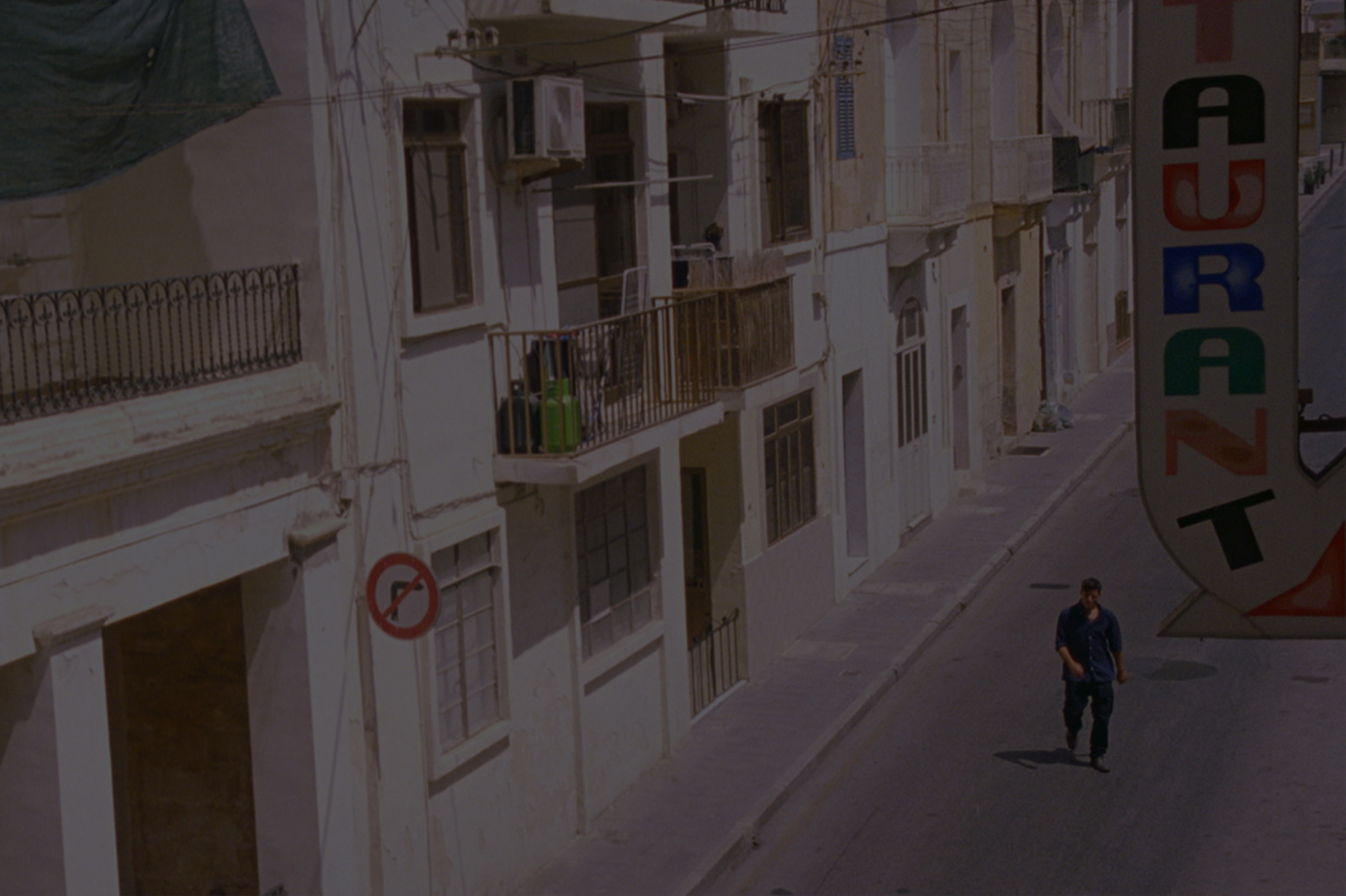
Throughout filming, Sant — who is also one of the editors — used open sets and allowed the real life of the streets to enter the frame. Trucks, buses, people, planes and distant sounds became part of the film’s language.
“The story is secondary to everything that’s happening around the characters,” Sant says, contrasting his approach with productions where background detail is usually controlled or softened. The decision to shoot on 16mm adds another layer — inconvenient, but also grungy and authentic. More importantly, he wanted the sense of nostalgia it brings to a story set in the present.
For Sant, it is this nostalgia that connects Dimitrios’ return to the older idea of homecoming, and to the pain embedded in that return. Muller, the film’s producer, adds that Malta’s scale is central to the premise
“I see the island as a microcosm of the global condition: capitalism, gentrification, mass tourism, transient populations, invisible labour…” Muller says. Her point is not that Buġibba stands for everywhere, but that in Malta certain pressures are more obviously visible.
Precarity, displacement, loneliness, and the desire to build a better life are not Maltese concerns alone — Żafżifa, in her view, allows audiences from different places to recognise emotional realities that exist across borders, regardless of geography.
“The hybrid form is central to this. It’s not just just an aesthetic choice, but a conceptual one: the film allows lived experience to disrupt narrative expectations, creating a space where reality itself feels unstable and fragmented,” she says.
That instability began its public journey at the Cairo International Film Festival, where Żafżifa premiered in an international context. Why Cairo? A festival audience, she says, brings attentiveness, but is also a meeting point for distributors, scouts, critics, programmers and other professionals.
“But perhaps most importantly, a premiere gives you confirmation that the film can travel. That a story can resonate emotionally and politically with audiences from completely different backgrounds,” she says.
The team is still pursuing selected festivals, but Muller is clear that festival life is short and competitive. The longer plan is to build circulation through independent cinemas, cinematheques, and alternative screening spaces. That approach gives the film a life beyond the usual festival window.
For Muller, Żafżifa also matters because it comes from within Malta. The island is often used as a backdrop by foreign productions, but Żafżifa looks directly at contemporary Maltese life.
“It’s important that Maltese people are able to see their own lives, environments, conditions and stories reflected on screen,” she concludes.
Żafżifa, the new Maltese film by writer, director and co-producer Peter Sant and producer Angelique Muller, introduces a new perspective as the town becomes a place under pressure, and a way of looking at contemporary Malta.
For Sant, Buġibba carries the marks of rapid population growth and demographic change. He is not interested in polishing that reality for the screen. Instead, he wants the work to question what happens to people when the place around them changes quickly, and what that change does to memory, behaviour, and belonging.
“Ultimately, I wanted to try to understand how we are conditioned by the environment we live in, how different people deal with that, and the repercussions it can have,” Sant says
This thinking is built into the film’s texture, which is crowded with buildings and cars. The sound is equally dense, shaped by traffic that rarely lets up. Occasionally, something breaks through, such as a narrow view of blue at the end of a road or a pause in the traffic.
“For me, these moments offer a temporary release from the claustrophobia of the town, a brief reminder that something exists beyond it,” he says.
This is Sant’s reading of Buġibba through the camera. The central character, Dimitrios, returns to a place that has moved on without him. Old friends have adapted to a changing economy, while new encounters reveal other forms of movement.
“Dimitrios doesn’t spell out the film’s argument for the viewer. Rather, he is a Baudelairean flâneur, observing, absorbing and drifting through spaces in transition.”
Throughout filming, Sant — who is also one of the editors — used open sets and allowed the real life of the streets to enter the frame. Trucks, buses, people, planes and distant sounds became part of the film’s language.
“The story is secondary to everything that’s happening around the characters,” Sant says, contrasting his approach with productions where background detail is usually controlled or softened. The decision to shoot on 16mm adds another layer — inconvenient, but also grungy and authentic. More importantly, he wanted the sense of nostalgia it brings to a story set in the present.
For Sant, it is this nostalgia that connects Dimitrios’ return to the older idea of homecoming, and to the pain embedded in that return. Muller, the film’s producer, adds that Malta’s scale is central to the premise
“I see the island as a microcosm of the global condition: capitalism, gentrification, mass tourism, transient populations, invisible labour…” Muller says. Her point is not that Buġibba stands for everywhere, but that in Malta certain pressures are more obviously visible.
Precarity, displacement, loneliness, and the desire to build a better life are not Maltese concerns alone — Żafżifa, in her view, allows audiences from different places to recognise emotional realities that exist across borders, regardless of geography.
“The hybrid form is central to this. It’s not just just an aesthetic choice, but a conceptual one: the film allows lived experience to disrupt narrative expectations, creating a space where reality itself feels unstable and fragmented,” she says.
That instability began its public journey at the Cairo International Film Festival, where Żafżifa premiered in an international context. Why Cairo? A festival audience, she says, brings attentiveness, but is also a meeting point for distributors, scouts, critics, programmers and other professionals.
“But perhaps most importantly, a premiere gives you confirmation that the film can travel. That a story can resonate emotionally and politically with audiences from completely different backgrounds,” she says.
The team is still pursuing selected festivals, but Muller is clear that festival life is short and competitive. The longer plan is to build circulation through independent cinemas, cinematheques, and alternative screening spaces. That approach gives the film a life beyond the usual festival window.
For Muller, Żafżifa also matters because it comes from within Malta. The island is often used as a backdrop by foreign productions, but Żafżifa looks directly at contemporary Maltese life.
“It’s important that Maltese people are able to see their own lives, environments, conditions and stories reflected on screen,” she concludes.
<br><br>