Coffee to Experience

Service Charge Debate Returns to the Table
October 14, 2026Are we sure the traditional bar model cannot be innovated and improved? And what if the key element to focus on were the barista?
Towards the end of last year, the Italian Espresso Institute organised a workshop in Milan where a series of studies were presented with the aim of addressing some of the critical issues affecting the coffee world.
Among them was a psychographic survey of consumers and baristas, carried out by Sylla, focusing on one of our most beloved drinks. Given that more than 100 million cups of coffee are consumed every day, it clearly plays no small part in the nation’s good mood.
And precisely because good humour is needed now more than ever, the survey deserves careful consideration, with a view to developing action plans capable of driving innovation: starting with the bar, which in our country plays a leading role not only as a place for refreshment, but also as a centre of social interaction.
Contrary to what many have written, often seemingly more interested in attracting attention than offering constructive criticism, the survey shows that people like our coffee. It received an impressive score of 8.7 out of 10, and it is certainly worth noting that 80% of respondents want their coffee to be Italian.
We could therefore be satisfied. However, there is still considerable room for improvement in the bar sector, and it is worth taking advantage of it.
If we consider that almost half of all coffee consumption takes place at home, mainly because of the tranquility and greater choice it offers, then on the one hand we should perhaps rethink the aesthetics of bars. On the other, two questions arise: shouldn’t bars broaden their offering and also become places where customers can buy coffee to enjoy in the comfort of their own homes?
But there is more: Quality, understood as the level of pleasure delivered, is the primary factor in choosing coffee. If the bar does not pay attention to quality, why not simply make coffee at home?
Celebrity endorsements have little influence when buying coffee; advice and recommendations matter far more. Could the bar become the place where people receive advice about what coffee to buy and discover new ways of preparing it at home?
60% of respondents would like the barista to say a few words about the coffee being served; 58% watch the coffee flowing from the machine’s spouts; 52% observe the barista’s technique. Overall, the relationship with the barista scores a solid 7 out of 10 when choosing a bar. Could the barista actually be the most important factor in a bar’s success?
A new barista? No, a barista renewed
If this is the case, the answer is not to replace the barista, but to create a new kind of barista.
Certain responsibilities remain essential to the point that the Italian Espresso Institute will not certify a bar unless it has a qualified barista. These include choosing the coffee blend and equipment, knowing how to extract coffee correctly and being able to evaluate it from a sensory perspective.
However, the psychographic research suggests that upgrading the role of the barista could produce remarkable results, both socially and economically.
The barista as storyteller
If the relationship with the barista is fundamental, if customers want consumption to become an experience, and if people seek advice from those they regard as knowledgeable, shouldn’t we elevate the barista to the role of storyteller?
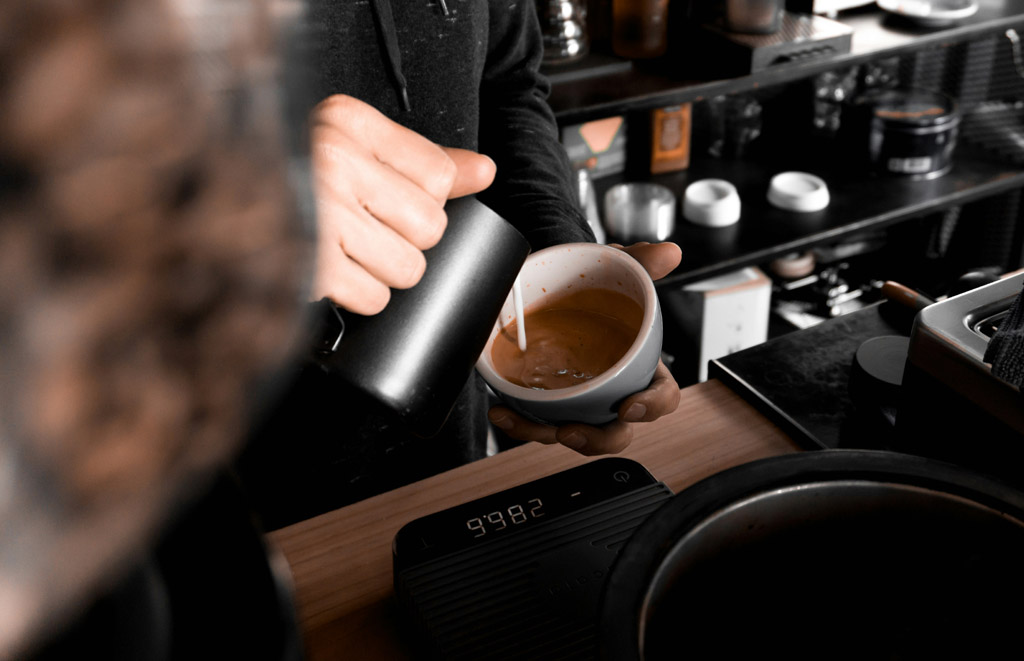
This does not mean turning the barista into someone who talks endlessly. Rather, it means someone attentive to customers, capable of welcoming them, communicating through impeccable gestures that they are preparing their coffee, and serving it with a phrase that enhances its appreciation.
Too often, we still experience precisely the opposite when approaching the counter: the barista barely looks at us, continues working as though we did not exist and, when we finally manage to place our order, gives no indication that it has even been heard. Eventually, a cup is placed in front of us and the barista walks away.
But imagine instead being served with: “Brazil, India and Costa Rica: notice the beautiful walnut note in this coffee.” Wouldn’t that be wonderful?
The barista as teacher
Although many bars have spaces perfectly suited to welcoming groups of people, very few offer activities designed to spread knowledge and educate customers about coffee, even though there are periods during the day when these spaces are practically empty.
All it would take is a sign:
“Tuesday 13th, 10 a.m.: Seminar on Ethiopian coffee, including tasting. Participation fee €…”
There are many successful examples of similar initiatives involving other products, yet in coffee they remain surprisingly rare.
Such activities could not only generate worthwhile additional revenue, but also elevate and give greater dignity to the profession by turning the barista into a teacher.
In all likelihood, the barista would then behave differently behind the counter too, because transferring knowledge encourages listening, deeper learning and reflection. It also makes people feel that their role matters.
The barista as sensory guide
People have always played games in bars. So why not introduce sensory games?
The simplest example could involve aroma trees. Alongside the coffee, customers could receive an attractive infographic containing circles representing the aromas most commonly identified in that particular coffee, inviting them to discover those aromas themselves.
The answers could then be revealed through a colourful aroma tree. Who would ever forget the coffee they experienced in this way?
We could go even further by providing a code customers enter into their phone browser. Once activated, it could display a genuine sensory evaluation form.
The customer plays, develops their coffee knowledge and, at the same time, provides valuable data for both the bar and the coffee roaster.
There are really only two excuses for not putting these ideas into practice: focusing exclusively on busy periods and lacking confidence in the quality of one’s own work.
A new coffee roaster for a new barista?
The relationship between the coffee roaster and the bar has always gone far beyond that of a simple supplier. Indeed, the survey showed that the coffee brand is one of the leading factors when choosing a bar, scoring 6.7 out of 10.
It is therefore difficult to understand why many roasting companies make so little effort to make their brand visible in bars, starting from outside the premises. Quite often, considerable detective work is required simply to discover which coffee a bar serves: looking for logos on cups, placemats or perhaps a packet sitting beside the grinder.
Beyond this, however, it would seem logical that the roaster itself should provide baristas with the knowledge they need to make this qualitative leap.
Academies there are plenty, but do they go beyond cappuccino with a smile?
In one survey, we identified more than 300 company-run training schools in Italy, dedicated to educating internal staff but, above all, customers. More than 100 of these belong to coffee-roasting companies.
The coffee world therefore boasts an extraordinary network for transferring knowledge.
Yet the teaching provided by these academies is often limited to how to extract coffee correctly and operate the equipment. Some go further and teach how to create attractive cappuccinos, while the pinnacle is reached when they competently teach sensory evaluation of the cup.
In reality, sensory evaluation should be the first thing baristas learn, because it guides the entire process. Without taking anything away from the work these academies already do, they should also transfer all the knowledge required to improve the culture of service.
They should transform the barista into a great ambassador and salesperson for their coffee, someone capable of educating customers about quality consumption while improving their own tasting skills.
In this way, the role of the barista would acquire greater professional dignity, while rewarding those who practice it with genuine skill.
To achieve this, coffee schools should equip themselves with appropriate digital tools, ranging from CRM systems to online learning platforms, allowing them to offer short online courses that gradually prepare baristas for more demanding in-person training.
What do coffee salespeople actually talk about?
We have been asking ourselves this for some time, convinced that their conversations should go beyond the weather, “How’s it going?” a polite question, though increasingly dangerous ,or worse still, price.
We admit that we often find ourselves asking baristas how much they know about the coffee they serve and the roasting company that produces it. Quite often, we are able to tell them things that interest and surprise them with things they did not know, interesting ideas they may have been considering for some time.
This is why we ask: what do coffee salespeople actually talk about?
Why aren’t they discussing training, innovation, coffee composition, production processes and ways of entertaining and engaging customers?
Perhaps because they themselves do not know. And this brings us back to the mission of the roasting company, to the academies and to the failure to create people capable of weaving relationships.
People have always played games in bars. So why not introduce sensory games?
The simplest example could involve aroma trees. Alongside the coffee, customers could receive an attractive infographic containing circles representing the aromas most commonly identified in that particular coffee, inviting them to discover those aromas themselves.
The answers could then be revealed through a colourful aroma tree. Who would ever forget the coffee they experienced in this way?
We could go even further by providing a code customers enter into their phone browser. Once activated, it could display a genuine sensory evaluation form.
The customer plays, develops their coffee knowledge and, at the same time, provides valuable data for both the bar and the coffee roaster.
There are really only two excuses for not putting these ideas into practice: focusing exclusively on busy periods and lacking confidence in the quality of one’s own work.
A new coffee roaster for a new barista?
The relationship between the coffee roaster and the bar has always gone far beyond that of a simple supplier. Indeed, the survey showed that the coffee brand is one of the leading factors when choosing a bar, scoring 6.7 out of 10.
It is therefore difficult to understand why many roasting companies make so little effort to make their brand visible in bars, starting from outside the premises. Quite often, considerable detective work is required simply to discover which coffee a bar serves: looking for logos on cups, placemats or perhaps a packet sitting beside the grinder.
Beyond this, however, it would seem logical that the roaster itself should provide baristas with the knowledge they need to make this qualitative leap.
Academies there are plenty, but do they go beyond cappuccino with a smile?
In one survey, we identified more than 300 company-run training schools in Italy, dedicated to educating internal staff but, above all, customers. More than 100 of these belong to coffee-roasting companies.
The coffee world therefore boasts an extraordinary network for transferring knowledge.
Yet the teaching provided by these academies is often limited to how to extract coffee correctly and operate the equipment. Some go further and teach how to create attractive cappuccinos, while the pinnacle is reached when they competently teach sensory evaluation of the cup.
In reality, sensory evaluation should be the first thing baristas learn, because it guides the entire process. Without taking anything away from the work these academies already do, they should also transfer all the knowledge required to improve the culture of service.
They should transform the barista into a great ambassador and salesperson for their coffee, someone capable of educating customers about quality consumption while improving their own tasting skills.
In this way, the role of the barista would acquire greater professional dignity, while rewarding those who practice it with genuine skill.
To achieve this, coffee schools should equip themselves with appropriate digital tools, ranging from CRM systems to online learning platforms, allowing them to offer short online courses that gradually prepare baristas for more demanding in-person training.
What do coffee salespeople actually talk about?
We have been asking ourselves this for some time, convinced that their conversations should go beyond the weather, “How’s it going?” a polite question, though increasingly dangerous ,or worse still, price.
We admit that we often find ourselves asking baristas how much they know about the coffee they serve and the roasting company that produces it. Quite often, we are able to tell them things that interest and surprise them with things they did not know, interesting ideas they may have been considering for some time.
This is why we ask: what do coffee salespeople actually talk about?
Why aren’t they discussing training, innovation, coffee composition, production processes and ways of entertaining and engaging customers?
Perhaps because they themselves do not know. And this brings us back to the mission of the roasting company, to the academies and to the failure to create people capable of weaving relationships.

Luigi Odello
is the President, Centro Studi Assaggiatori – Academic Secretary IASA. Oenologist, journalist, and professor of sensory analysis at Italian and international universities; founder of Odello Associati and Good Senses; president of the Centro Studi Assaggiatori and the International Institute of Coffee Tasters; CEO of Narratori del Gusto, the Istituto Eccellenze Italiane Certificate, and the International Chocolier Institute; academic secretary of the International Academy of Sensory Analysis; member of the board of directors of the National Italian Espresso Institute and the National Grappa Institute; coordinator of the Conference of Academies and of numerous scientific committees; and editor-in-chief of L’Assaggio, Sensory News, Coffee Taster, and Grappa News.
Click here to see Horeca Issue 25 online